InstanceSplat

Instance-Aware Feed-Forward 3D Gaussian Splatting for Scene Understanding

Minchao Jiang1,2 Xiaoxuan Ma3 Shunyu Jia4 Haoru Wang5 Zhang Liang4 Wentao Zhu2

1 Shanghai Jiao Tong University 2 Eastern Institute of Technology, Ningbo 3 Carnegie Mellon University
4 Xidian University 5 Peking University

TL;DR We propose an instance-aware feed-forward 3DGS method.

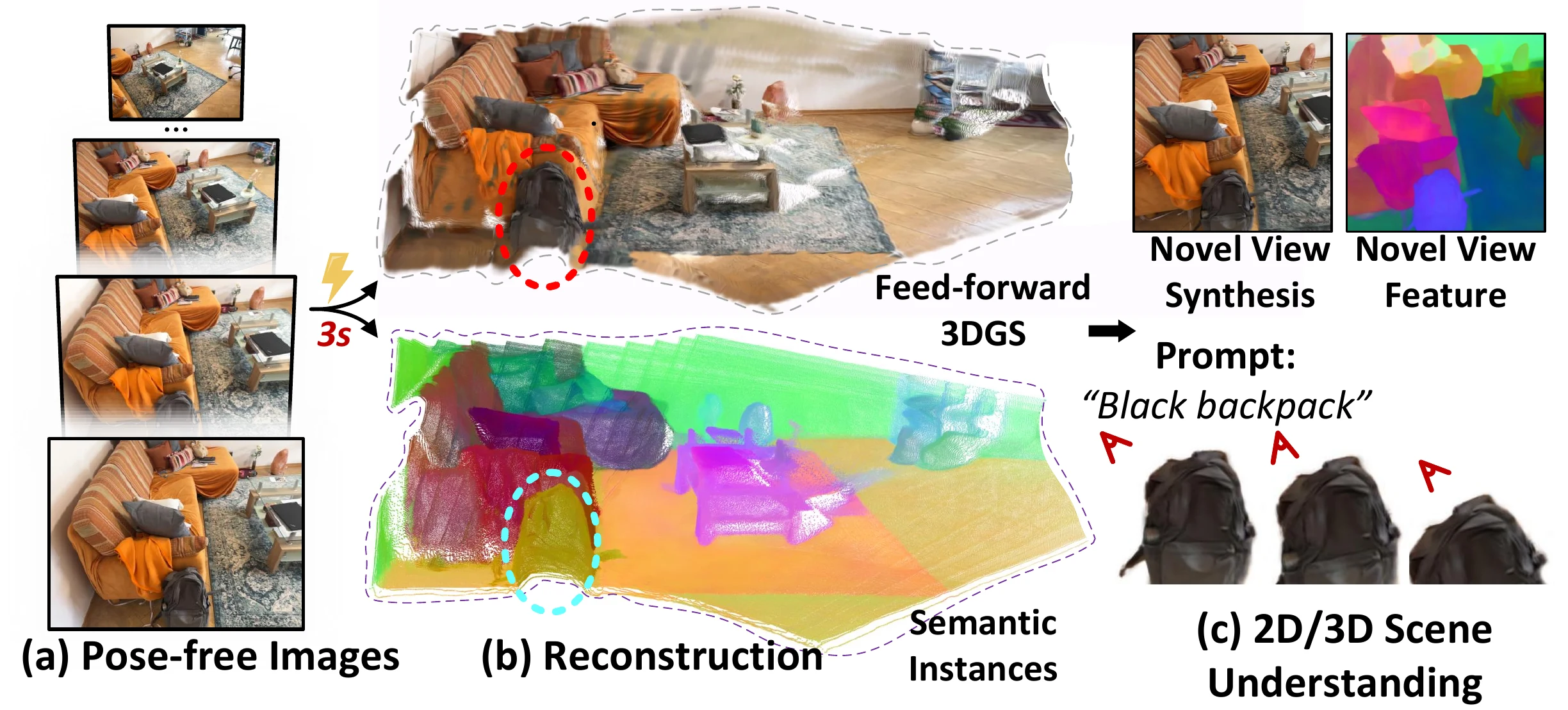
InstanceSplat takes pose-free multi-view images and produces an instance-aware 3D Gaussian representation for reconstruction, instance segmentation, and open-vocabulary scene understanding.

Given pose-free multi-view images (a), InstanceSplat jointly predicts explicit 3D Gaussians with compact instance and open-vocabulary semantic features (b). Shared 3D geometry provides cross-view consistency, while instance cues enhance boundary-aware 3DGS reconstruction and semantic coherence. The resulting representation supports novel-view synthesis (NVS), instance segmentation, and open-vocabulary scene understanding (c).

Abstract

Feed-forward 3D Gaussian Splatting (3DGS) enables efficient and generalizable 3D reconstruction, but current feed-forward 3DGS methods for scene understanding remain largely category-oriented. In contrast, instance-aware 3DGS methods typically rely on per-scene optimization and often decouple reconstruction from instance and semantic learning, limiting reciprocal interactions among them. We present InstanceSplat, a unified feed-forward 3DGS framework for generalizable 3D reconstruction and instance-aware scene understanding from pose-free multi-view images. In a single forward pass, InstanceSplat constructs an instance-aware Gaussian representation that jointly encodes appearance, geometry, instance identity, and language-aligned semantics. Shared 3D Gaussians ground instance identities across views, producing renderable and cross-view-consistent instance features. To allow reconstruction and scene understanding to benefit from each other, we further design an instance-centric learning strategy that connects reconstruction, instance learning, and semantic learning through shared instance structure. Specifically, instance cues guide reconstruction, language-aligned semantics strengthen the discrimination of confusing same-category instances, and instance regions aggregate semantic evidence into coherent object-level predictions.
Method

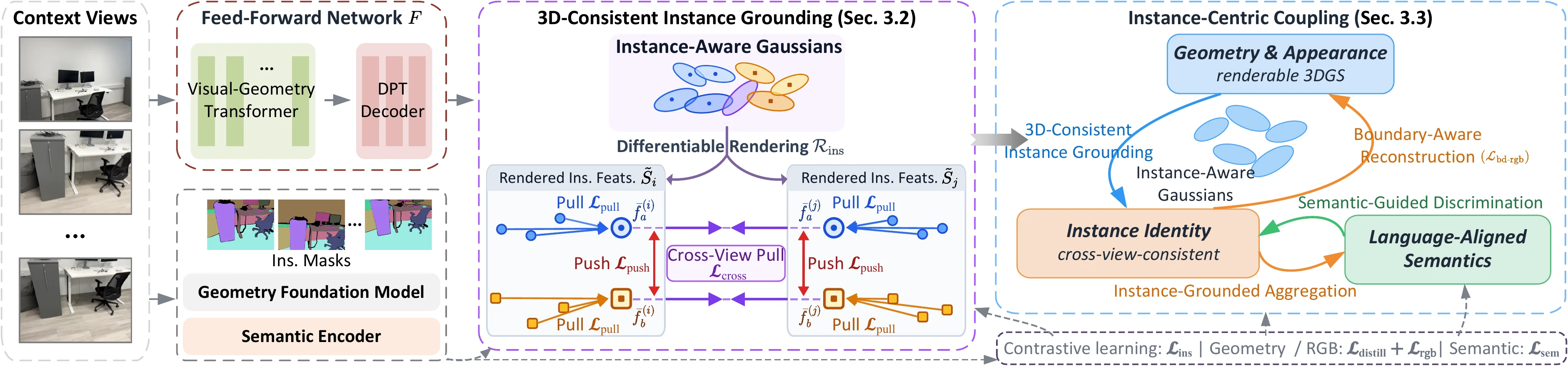
Overview of the InstanceSplat architecture, including the feed-forward backbone, 3D-consistent instance grounding, and instance-centric coupling.
Given pose-free multi-view images, the feed-forward backbone constructs an instance-aware Gaussian representation. 3D-consistent grounding and instance-centric coupling then connect reconstruction with instance and semantic learning.
01

Instance-Aware Gaussian Representation

Each Gaussian carries appearance, geometry, an 8-dimensional instance embedding, and a compact language-aligned semantic feature. Confidence-aware voxelization merges redundant primitives while preserving this shared structure.

02

3D-Consistent Instance Grounding

Differentiable feature rendering supervises shared Gaussians in image space. Prototype-based contrastive learning promotes compact instances, separates different objects, and aligns identities across views.

03

Instance-Centric Coupling

Instance boundaries guide reconstruction, semantic similarity emphasizes confusing same-category objects, and predicted instance regions aggregate semantic evidence into coherent object-level labels.

Experiment

Interactive Instance Removal

Click an instance to hide or restore its full Gaussian group, and drag the scene to orbit.

Loading full Gaussian scene...

Drag to orbit · scroll to zoom · click an instance button to hide or restore that complete Gaussian group.

Open-Vocabulary Instance-Level 3D Localization

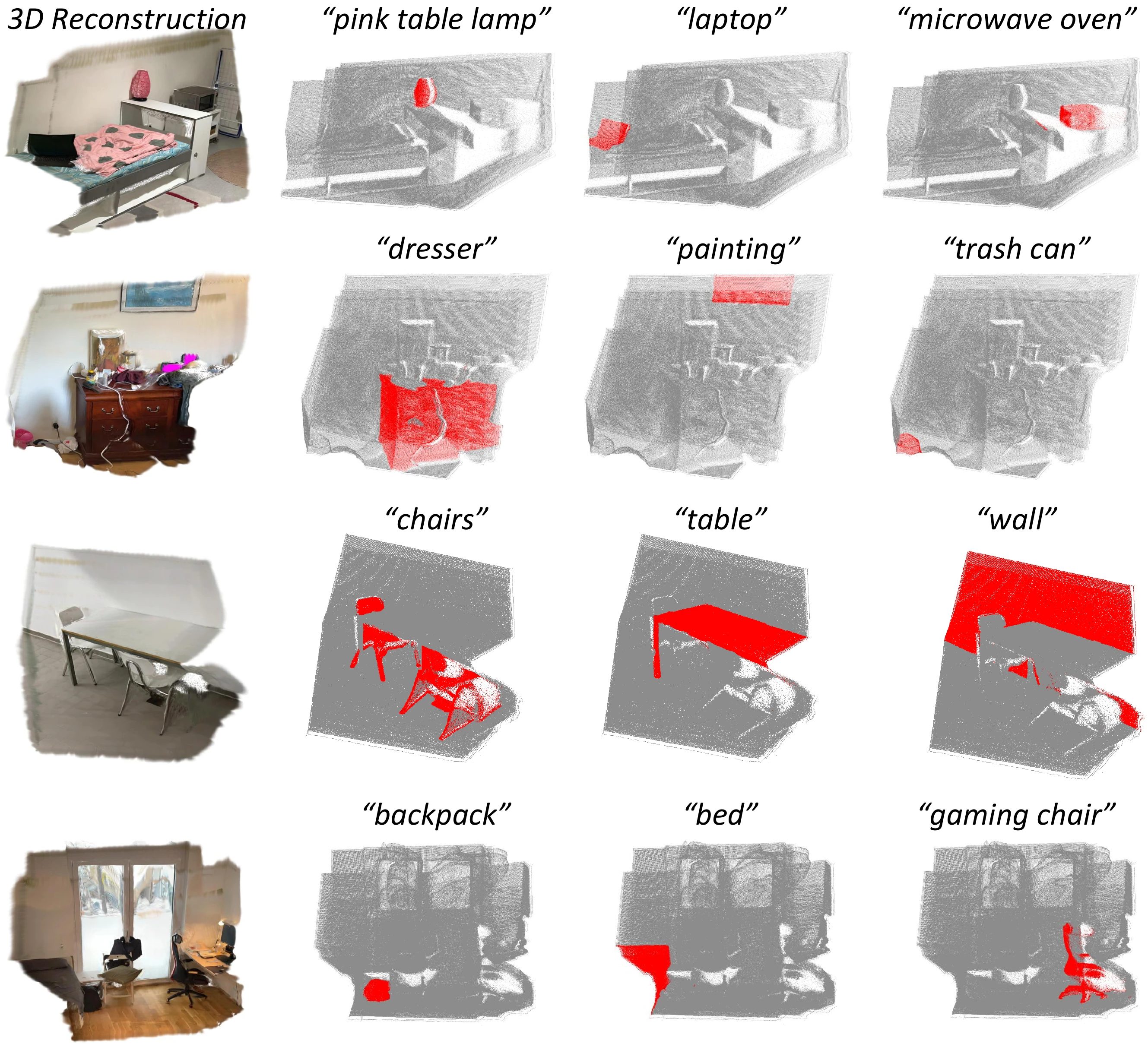
Text queries match semantic prototypes to clustered 3D Gaussian groups, which are highlighted in red.

Open-vocabulary instance-level 3D localization results. Text queries identify complete Gaussian groups highlighted in red across several reconstructed indoor scenes.
Open-vocabulary instance-level 3D localization on ScanNet. Text queries retrieve the corresponding 3D Gaussian groups, highlighted in red.

Reference

Citation

@misc{jiang2026instancesplat,
  title  = {InstanceSplat: Instance-Aware Feed-Forward 3D Gaussian
            Splatting for Scene Understanding},
  author = {Minchao Jiang and Xiaoxuan Ma and Shunyu Jia and Haoru Wang
            and Zhang Liang and Wentao Zhu},
  journal = {arXiv preprint arXiv:2608.07144},
  year   = {2026}
}